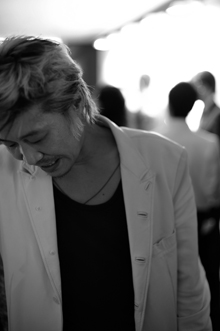
Kakinuma, Koji (Artist / CEO)
Artist
Born 1970, Yaita City, Tochigi Prefecture, Japan. He started studying Japanese calligraphy at the age of five, and began apprenticeship under his father Suiryu Kakinuma and afterwards Yukei Teshima, a Sanpitsu or “three brushes” of the Showa Era, and Ichijo Uematsu. A graduate of the Department of Visual and Performing Arts, Tokyo Gakugei University, Kakinuma was invited as a visiting scholar at Princeton University from 2006-2007.
Major prizes and awards include the Higashikuninomiya International Cultual Award (2012), the 4th Teshima-Yukei Award (2009), “The Huge Work Prize” at the 50th Anniversary of Dokuritsu Shojindan Foundation (2002), the Mainichi Award, Mainichi Calligraphy Exhibition (1996 and 1999).
Based on his traditional calligraphic techniques, his work has been extended beyond a conventional category of calligraphy and “Nowness *1” his very important concept. His notable works include “Huge works *2”, which are large-scale calligraphies using an enormous brush, a new method he developed which he named “Trance work *3”, and his unique and modern concept called “Circle work *4”. He is the first living calligrapher to ever hold a solo exhibition at the Kanazawa 21st Contemporary Art Museum in Japan (2013-2014). Those works are now part of the museum’s permanent collection. 2020 Tokyo Olympic Paralympic official art poster artist.
Besides his two- and three-dimensional works as well as films, his extensive performing styles has been demonstrated in numerous sites in the world including the Metropolitan Museum, NY, Washington D.C. Kennedy Center, Philadelphia Museum, London County Hall, and the Earth Cerebration – KODO.
*1: NOWNESS
“NOWNESS” is Kakinuma’s approach to express the ontological nature of time in calligraphy. It takes the view that the dots, the lines from his brush represent nothing but the ultimate expression of presentism. “NOWNESS” is a sliver of a moment between past and future and the flow of time immediately make it “the past “,with the continuous creation of new “NOWNESS”. In the constant state of expressing “NOWNESS”, this important concept has always been the subtitle for all his works.
*2: HUGE WORKs
His large–scale masterpieces such as “Phoenix” (750×1100cm), “Go Go” (700×1200cm), “Traveling Alone ” (360×960cm), “One” (270×515cm), “B-EAT” (360×720cm) , “Life” (360×480cm) are achieved by Kakinuma’s wild outburst of creativity – with only a single attempt using extra-large brush.His performances have been well received all over the world as an exceptional expression of modern art.
*3: Trance work
Trance work is one of Kakinuma’s representative modes of expression that he repeatedly writes the same word or phrase such as “who are you, who are you, who are you… “, “live, live, live… “, “nowness, nowness, nowness … “, “here, here, here … “, with being deeply engaged with its theme. Although he repeats the same word or phrase, the definition of the words or the phrase varies moment by moment as he continues his work in the state of trance.
*4: Circle work
Most of the works in the 3500 years of calligraphic history are either square or rectangle shapes. The “Circle work “concept was brought into existence based on Kakinuma’s introspection if it definitely needs to be that structure. Upending the conventional thinking and style, his aesthetic calligraphy work is a collaboration of modernism and Zennism.